When you hear “stem cells,” it is easy to assume that making more of them must be a good thing. A new mouse study offers a useful reminder: cells also need the right instructions.
Researchers found that immune cells help keep skin stem cells from becoming overactive. When that communication was disrupted, cells multiplied more, but their descendants did not finish developing properly. The skin’s protective barrier became weaker, not stronger. The findings were published in Science on October 29, 2026. Read the study abstract.
The skin needs both new cells and finished cells
Skin stem cells help supply the specialized cells that form the body’s outer covering. Maintaining that covering involves a balance: keeping a supply of stem cells while producing cells ready to do their protective work.
The Rockefeller University team identified a communication circuit involving Langerhans cells, immune cells living in the outer skin layers. These cells respond to nearby microbes and send chemical messages to skin stem cells. Rockefeller University announcement.
A key messenger is called PGE2. In the mouse experiments, it helped limit stem-cell multiplication while supporting the development of mature skin cells. Disrupting the pathway disturbed that balance. Study abstract.
What changed in the experiments?
The team used experiments that removed Langerhans cells or examined their signaling pathway. Rockefeller reports that disrupted communication was associated with an impaired barrier, changes in the skin’s resident bacteria and reduced production of some natural antimicrobial substances. Those are laboratory findings, not evidence that a particular skin product can improve the system. University research summary.
At a glance: how the signaling pathway affected skin
| Feature | With the signaling circuit working | When the pathway was disrupted |
|---|---|---|
| Stem-cell activity | Cell multiplication was kept in check | Stem cells became overactive |
| Development of new skin cells | Supported maturation into specialized cells | Final maturation was impaired |
| Protective barrier | Helped maintain barrier integrity | Barrier function weakened |
Qualitative summary of the mouse findings reported in the Science abstract. This table is not a comparison of treatments or a measurement of effects in people.
What this does not mean
This was research in mice, not a clinical trial of a stem-cell injection, cosmetic product or medicine. It does not establish a new treatment for a skin condition or justify changing a skincare routine.
The work also does not show that every way of increasing stem-cell activity is harmful. It identifies a particular regulatory pathway in a particular tissue. Turning that finding into a safe human treatment would require additional research.
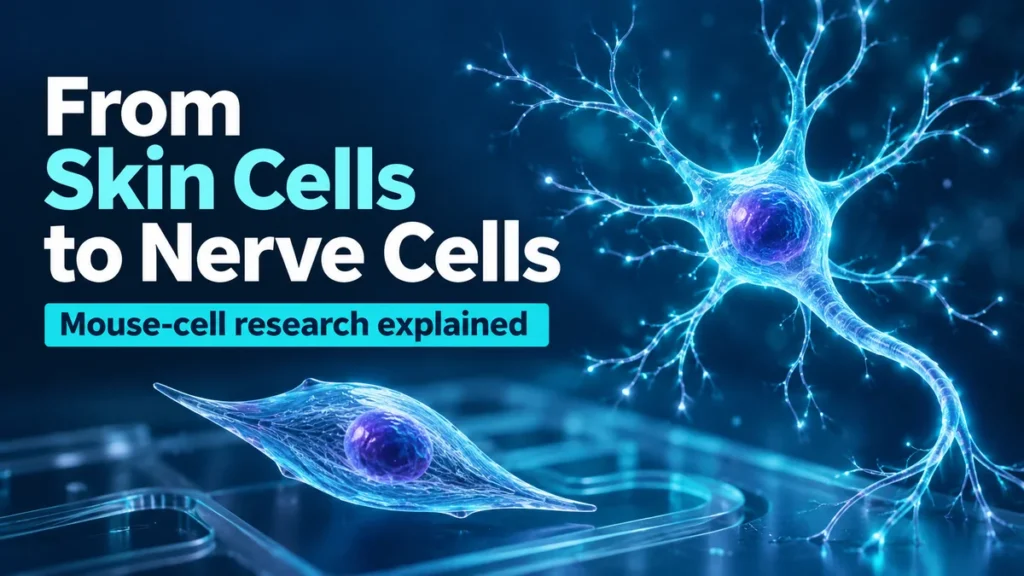
For readers following regenerative medicine, the important distinction is between having more cells and having cells doing the right job. Our earlier article on turning skin cells into nerve cells explores a different question: changing a cell’s identity. This study instead examines how cells already in the skin are regulated.
The takeaway: Healthy tissue depends on coordination, not simply faster growth. This study helps explain that coordination; it is not a new treatment announcement.