For the millions of men and women dealing with hair loss, the search for an effective solution can be frustrating. While options like medications and hair transplants exist, the holy grail has always been to find a way to regenerate natural hair growth. This is where stem cell therapy for hair loss is generating significant excitement.
But does it actually work? The short answer is that it shows incredible promise, and the science is rapidly advancing.
The Problem: Dormant Hair Follicles
In most common forms of hair loss, like androgenetic alopecia (male or female pattern baldness), the hair follicles don’t disappear. They shrink and go dormant, losing their ability to produce healthy, thick hair strands .
The key to reversing hair loss is to reawaken these sleeping follicles.
How Stem Cells Can Help
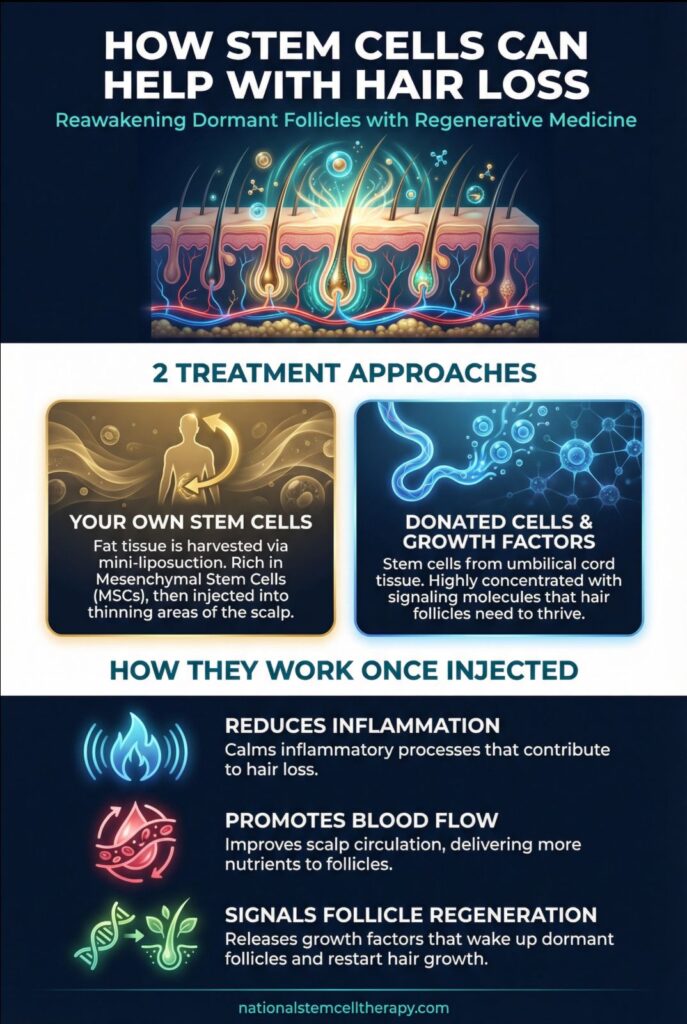
Stem cell therapy for hair loss is based on the idea that stem cells can provide the necessary signals to kickstart these dormant follicles back into action. The process typically involves two main approaches:
- Using Your Own Stem Cells: This is the most common method. A small sample of fat tissue is taken from the patient (usually from the abdomen or flank) in a mini-liposuction procedure. This fat is rich in Mesenchymal Stem Cells (MSCs). The fat is then processed to concentrate these stem cells, which are then injected directly into the areas of thinning on the scalp.
- Using Donated Cells or Growth Factors: Some treatments use stem cells or growth factors derived from sources like umbilical cord tissue. These products are highly concentrated with the signaling molecules that hair follicles need to thrive.
Once injected into the scalp, these stem cells and growth factors are thought to work by :
•Reducing Inflammation: Calming the inflammatory processes that can contribute to hair loss.
•Promoting Blood Flow: Improving circulation to the scalp, bringing more nutrients to the follicles.
•Signaling Follicle Regeneration: Releasing growth factors that tell the dormant follicles to wake up and start growing hair again.
What Does the Research Say?
While still considered an emerging treatment, the clinical evidence is growing. Multiple studies have shown that stem cell therapy can lead to significant improvements in both hair density and hair thickness .
It’s important to note that results can vary. Stem cell therapy tends to work best for people with early to moderate hair thinning, where the follicles are still viable and can be reawakened. It is generally not effective for areas that are completely bald, as the follicles may be too damaged to be revived .
The Takeaway
Stem cell therapy is not a magic cure for baldness, but it is a scientifically-backed treatment that is showing real results for many people struggling with hair loss. By harnessing the body’s own regenerative power, it offers a new and exciting way to fight hair thinning and promote natural regrowth.
As research continues to advance in 2026 and beyond, stem cell-based therapies are poised to become a cornerstone of modern hair restoration.
References
[1] Acorn.me. “Hair Loss in 2025? Here’s What To Do, According to Scientists.”
[2] Forhair. “Follicular Stem Cell Treatments For Hair Restoration.”
[3] PMC. “Stem Cell Applications in Human Hair Growth: A Literature Review.”
[4] Linda Alfieri. “Stem Cells in a Syringe? Busting Myths About Hair Growth Injections.”